

The One Minute Preceptor Model
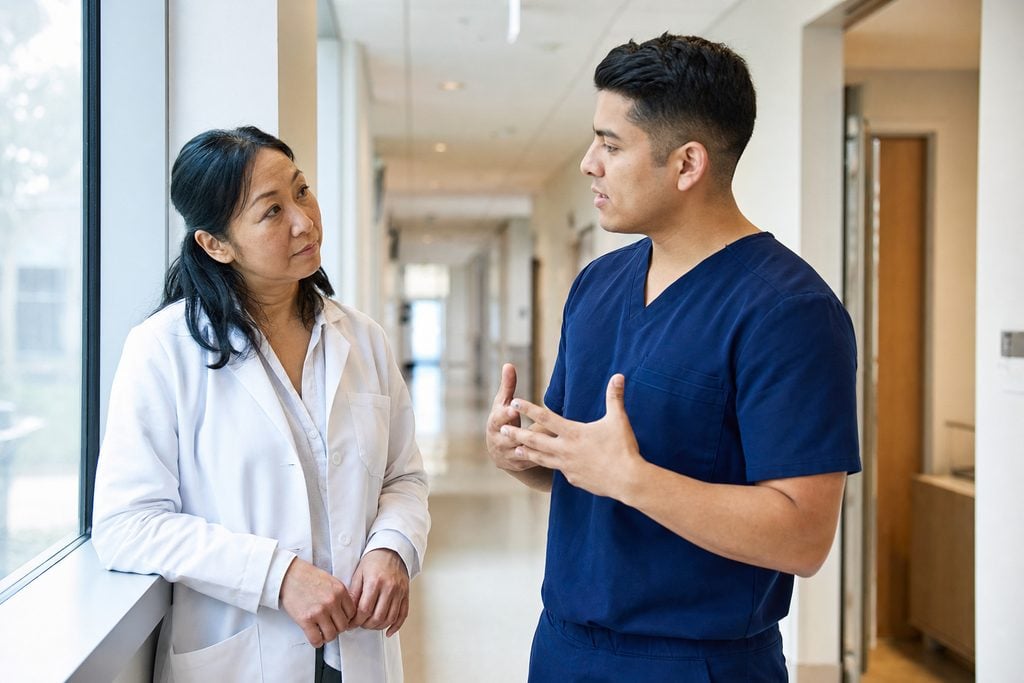
The One Minute Preceptor is a five-step way to teach in the short conversation after your student presents a patient. Instead of answering their question for them, you ask what they think, find out why, teach one point they can use again and give specific feedback. If you precept NP students, here’s how each step sounds in clinic, how to use it on a full schedule and which mistakes to avoid.
TL;DR
- The One Minute Preceptor model has five microskills: get a commitment, probe for supporting evidence, teach general rules, reinforce what was done right and correct mistakes.
- Use it when your student has seen a patient and comes to you with the case.
- Each step is a question or a short comment, so you can teach between patients.
- Research, including studies with NP preceptors, links the model to more feedback and stronger diagnostic reasoning.
- As a Clinical Match Me preceptor, you’ll earn $1,000+ per rotation, and you decide which students to send offers to and how many to take.
What’s the One Minute Preceptor model?
It’s a framework for the teaching conversation that follows a case presentation, made up of five short teaching behaviors called microskills. Jon Neher, Katherine Gordon, Barbara Meyer and Nancy Stevens described it in 1992 in The Journal of the American Board of Family Practice, writing for family physicians who teach part-time and for new faculty. The five microskills are:
- Get a commitment
- Probe for supporting evidence
- Teach general rules
- Reinforce what was done right
- Correct mistakes
It’s also called the 1 minute preceptor, or OMP for short. In a 2003 follow-up in Family Medicine, Neher and Stevens wrote that the model had been “widely adopted in fellowship and teaching programs.”
Any clinician who teaches can use the steps in a visit where your student sees the patient first and then presents the case to you. Once you know the steps, the authors encourage you to reorder them or use only the ones that fit. A quick follow-up may need only a commitment and one piece of feedback.
How do you use the One Minute Preceptor with an NP student?
Start right after your student finishes presenting. Here’s each microskill in a family practice visit: a 46-year-old patient with a week of low back pain that began after he moved furniture.
Get a commitment
Ask for your student’s assessment and plan before you share yours. Committing to an answer makes your student think through what they just learned about the patient, so they learn more from the case.
In clinic: Your student finishes the presentation and waits for you. Ask, “What do you think is going on?” When they say it’s a muscle strain, follow with “What would you like to do?”
Some students hesitate because they’re worried about being wrong or being evaluated. For them, Neher and Stevens suggest asking, “What if I weren’t available, what would you do for this patient?”
Probe for supporting evidence
Ask what led your student to that answer. As they explain, you’ll see what they know, where the gaps are and what to teach next.
In clinic: Ask, “What made you think it’s a strain, and what else did you consider?” Your student points to the lifting and the normal strength in his legs. They haven’t asked about fever, weight loss, numbness or changes in bladder or bowel control, so now you know what to teach.
Teach general rules
Teach one point your student can use with the next patient like this one. Neher and Stevens contrast a general rule, “ACE inhibitors reduce morbidity and prolong life in patients with dilated cardiomyopathy,” with an instruction that fits only one case: “This patient needs captopril.”
In clinic: “With back pain, rule out the serious causes before you treat the common one. At every back pain visit, ask about fever, weight loss, numbness and bladder or bowel changes, and document the answers.”
Reinforce what was done right
Tell your student exactly what they did well, so they know to do it again. Focus on what helped the patient, the team or the clinic.
In clinic: “You explained the plan in plain words and asked him to tell you when he’d come back. Keep doing that with every patient.”
Correct mistakes
Explain what to do differently next time, and be specific. Start by asking your student what they’d change, since, as the authors point out, people learn most from the mistakes they find themselves.
In clinic: “Let’s go back in and ask about those warning signs together before he leaves. Next time, ask about them before you present, so you can include them in your assessment.”
Can you use the One Minute Preceptor on a busy day?
Yes. Each step takes a question or a short comment. These habits help on a full schedule:
- Teach your student to lead with a commitment. Ask them to open every presentation with their assessment and plan. Neher and Stevens note that this saves time and lets you listen for the details that matter as they present. Before you start, they suggest telling your student, “I am particularly interested in what you are thinking because it helps me be a better teacher.”
- Set a time for feedback. If you rarely get to the feedback steps, set aside a specific time for them, such as after each visit you observe.
- Practice one microskill at a time. While you learn the model, focus on one microskill per clinic session and take a few minutes at the end of the day to reflect on how it went.
What mistakes should you avoid?
Watch for these mistakes, flagged by Neher and Stevens and by the UC Riverside School of Medicine faculty development team:
- Taking over the case. Ask a clarifying question or two if you need to. Ask many more and you’re running the case instead of your student.
- Quizzing on isolated facts. Ask how your student reached a decision rather than testing textbook knowledge.
- Teaching everything on one case. Neher and Stevens write that learners “cannot integrate more than a few general rules per case.” Choose the point that matters most for this student and this patient, not just the topic you know best.
- Saying “great job.” General praise doesn’t tell your student what to repeat, so name the behavior.
- Skipping the correction. When you let an error pass to avoid an awkward moment, your student will likely repeat it.
Does the One Minute Preceptor work with NP students?
Yes. The research began with physicians and residents, and newer studies include NP preceptors and NP trainees. A 2019 systematic review in the Journal of the American Association of Nurse Practitioners found the model “supported by literature for its effectiveness as a teaching model and preference by students and preceptors,” with “the potential to overcome clinicians’ barriers to precepting nurse practitioner students.”
- Residents. In a randomized controlled trial, internal medicine residents took a one-hour training session, and their students rated them higher on every microskill except teaching general rules. The authors described the gains as modest. Since teaching general rules didn’t improve, it may be the step to practice most.
- An NP residency. At a Veterans Affairs primary care NP residency, preceptors learned the model in a one-hour workshop. After 12 weeks, the NP trainees’ diagnostic reasoning scores had improved.
- NP preceptors. In a pilot study in Hawaii, nine NPs completed training in the model. It improved their confidence as preceptors and positively affected their decision to precept.
How do you get ready to precept an NP student?
Talk with your practice and check what the school needs. New to teaching? Our guides explain what a preceptor is and what a clinical preceptor is in NP education, including how you and the student’s faculty share the work.
- Agree on the basics. Decide with your practice how many students you’ll take and which days they’ll be in clinic.
- Check the school’s paperwork. Each program sets its own requirements to precept NP students. Many programs also need an affiliation agreement with your practice, so read what an affiliation agreement is before you sign one.
- Start with routine visits. Book a little extra time for the visits your student leads at first, and tell patients you’re overseeing their care.
The microskills give each teaching conversation a structure. For the rest of the role, read our guide on how to be a good NP preceptor.
Common precepting questions
Does the One Minute Preceptor take only one minute?
Not always. The name describes how brief the teaching conversation is. When a student is guessing on an important topic, Neher and Stevens suggest assigning reading or planning a review session for later instead of teaching it all between patients.
What are the four steps of precepting?
The model has five steps, but it’s easy to think of it in four parts: get a commitment, probe for supporting evidence, teach a general rule and give feedback. Neher and Stevens discuss the last two microskills, reinforcing what went well and correcting mistakes, together as the feedback that closes the conversation.
What are some examples of preceptor comments?
Good preceptor comments are specific and describe what the student did. Neher and Stevens recommend feedback that’s timely, expected, specific to the case and focused on behavior, in words that describe rather than judge. For example:
- “You explained the new medication in plain words, and the patient’s questions dropped.”
- “Your note lists the plan but not your reasoning. Add the findings that support your assessment.”
Written evaluations work the same way. Name the behavior and the next step, such as “Presents cases clearly and commits to a plan. Next goal: build a broader differential before narrowing it.”
How is the One Minute Preceptor different from SNAPPS?
The difference is who leads. In SNAPPS, a learner-centered model published in 2003, your student leads the conversation in six steps: summarize the history and findings, narrow the differential to two or three possibilities, analyze them, probe you with questions, plan management and select a case-related issue to study on their own. With the microskills, you ask the questions. If your student uses SNAPPS, their summary and differential give you the commitment, and you can still teach and give feedback.
How much do preceptors get paid?
It depends on the arrangement, and many preceptors teach students without pay. As a Clinical Match Me preceptor, you’ll earn $1,000+ per rotation. Set your own preceptor pay: the standard $1,000 flat fee, a higher flat fee or an hourly rate. Browse our open preceptor jobs to see where students need a preceptor.
Precept NP and PA students with Clinical Match Me
Precepting is a great way to improve care in your specialty, and the One Minute Preceptor gives you a simple structure for every case your student presents.
As a Clinical Match Me preceptor, you’ll earn $1,000+ per rotation. Review placement requests from NP and PA students on your own schedule. You decide which students to send offers to and how many to take. We handle the affiliation agreement with the student’s school using their existing template. Non-exclusive, so you can keep any other precepting arrangements you have.
If you manage a practice, it can become a clinical rotation site for NP and PA students instead.
Learn how to become a preceptor with us, or sign up free and start receiving placement requests today. We pay you when your student starts the rotation.
Ready to find your NP preceptor?
Sign up free and start receiving offers from preceptors in your specialty today.
No credit card required. No obligation to pay.