

What Is a Clinical Rotation?
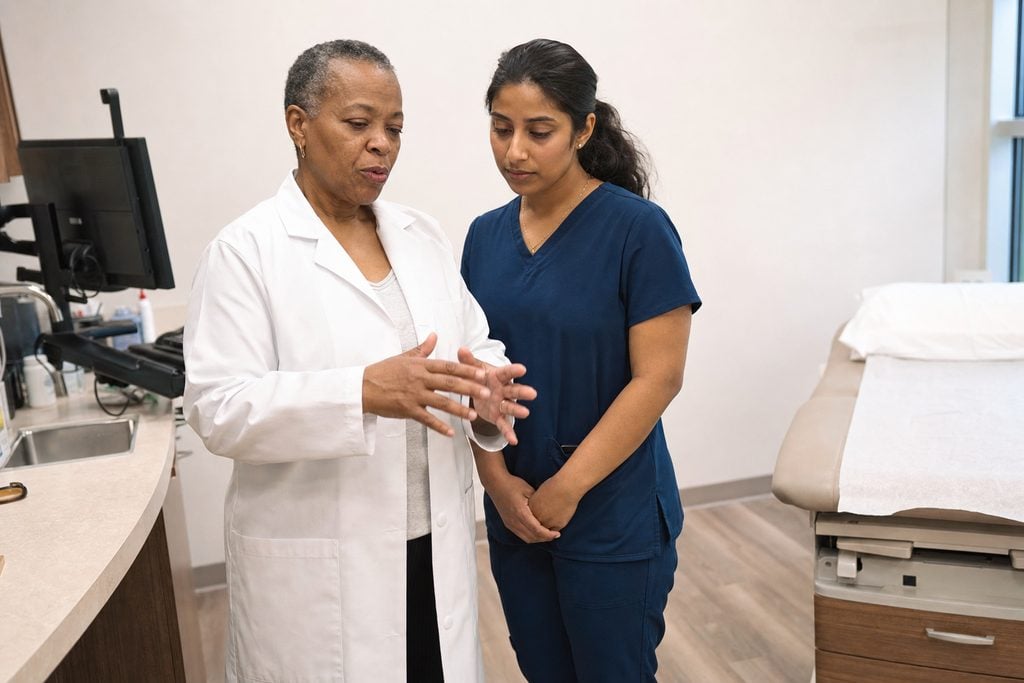
What is a clinical rotation? It’s a period of hands-on patient care at a hospital, clinic or other healthcare site that counts toward your degree. An experienced clinician supervises and teaches you while you care for real patients, usually in one specialty or setting at a time. Nursing, nurse practitioner (NP), physician assistant (PA) and medical students all complete clinical rotations.
If you’re an NP student, your rotations are where you learn to care for patients as a nurse practitioner. We’ll explain what you’ll do, who supervises you, how long rotations last and how to find a placement. We’ll also show how clinical rotations work in nursing, PA and medical school.
TL;DR
- A clinical rotation is supervised patient care at a clinical site, and it counts toward your degree.
- As an NP student, you’ll work with a preceptor your program approves, in one specialty or setting at a time.
- NP rotations typically run over one semester, and you’ll complete several to reach your program’s total clinical hours.
- Clinical rotations are part of your education, so you complete them as a student rather than an employee.
- Nursing, PA and medical students complete clinical rotations too, and medical schools call them clerkships.
What does clinical rotation mean?
A clinical rotation is a block of training in which you care for patients in one specialty or setting, such as family practice, pediatrics or a hospital unit. It’s called a rotation because you move from one specialty or site to the next over the course of your program. The Association of American Medical Colleges (AAMC) says rotations give medical students “firsthand experience working with patients in various specialties under direct supervision.”
Programs use different names for clinical rotations. Nursing and NP students often call them clinicals, and NP programs organize them as clinical courses. PA programs call them supervised clinical practice experiences, and medical schools call them clerkships. Whatever the name, a rotation is coursework that takes place with patients instead of in a classroom.
What is a clinical rotation in an NP program?
In an NP program, a clinical rotation is a set number of hours of patient care with a preceptor, at a site your program approves. Under the 2022 Standards for Quality Nurse Practitioner Education, your program aligns your placements with your role and your population focus, the group of patients your track prepares you to care for.
What do you do during a clinical rotation?
You’ll care for real patients alongside your preceptor and take on more of each visit as your skills grow. The national standards include a sample checklist for preceptors who are setting up a clinical rotation. It asks your preceptor to:
- Orient you to the site, its policies, its electronic health record and the clinical team before you see patients
- Go over your course objectives and learning goals with you
- Plan your tasks and patient cases for each clinical day
- Set a plan for you to move from observing visits to conducting them with minimal help
- Verify your clinical hours
Early on, expect to watch your preceptor work. Later, you’ll take the history, examine the patient and present your assessment and plan to your preceptor.
Who supervises your clinical rotation?
Your preceptor supervises you at the site, and your faculty oversee your progress. The national standards describe a preceptor as a qualified clinician who works with your faculty to supervise your clinical learning at a site your program approved. The same checklist asks preceptors to be present to observe all your clinical activities. Learn more about what a preceptor is and what they’re responsible for during your rotation.
How long is a clinical rotation?
NP rotations typically run over one semester. Your program sets the hours for each rotation, and the number of weeks depends on how many hours a week you spend at your site. Our guide to how long clinical rotations are shows how to turn those hours into weeks.
How many clinical hours do you need?
The 2022 national standards set a minimum of 750 direct patient care hours for every NP population-focused track, and ANCC and AANPCB certification require at least 500 faculty-supervised clinical hours. Your program sets its own total, and you’ll complete several rotations to reach it. We explain where each number comes from in our guide to nurse practitioner clinical hours requirements.
What counts toward your clinical hours?
Direct patient care in your population focus counts. Under the national standards, care you give through telehealth can count toward the 750 hours, while simulation can’t. For the activities that do and don’t count, see what counts as clinical hours.
Which specialties will you rotate through?
Your NP track decides. The national standards name six population foci: adult-gerontology (primary care or acute care), pediatrics (primary care or acute care), family/individual across the lifespan, neonatal, women’s health/gender related, and psychiatric-mental health across the lifespan.
On the family nurse practitioner (FNP) track, you’ll care for patients of every age, so your rotations might include family practice, pediatrics and women’s health. On the psychiatric-mental health nurse practitioner (PMHNP) track, your rotations focus on mental health care. To see which specialties students request on each track, read our guide to NP clinical rotations by specialty.
How do you find a clinical rotation?
Your program decides how placements work. It may secure your sites and preceptors for you, or it may ask you to find your own preceptor. Either way, your faculty approve every placement before you start. The national standards say faculty “assess and approve all clinical placements,” including sites and preceptors that students find themselves.
Your school also needs a contract with your clinical site, often called an affiliation agreement. The national standards ask NP programs to keep current contractual agreements with the preceptors or sites where students train. When you match with an NP preceptor through Clinical Match Me and your school requires an affiliation agreement, we handle it using your school’s existing template.
If you’re finding your own preceptor, our guide on how to find an NP preceptor explains where to search and how to reach out. A preceptor placement service can also help you arrange your NP clinical placement.
What is a clinical rotation in nursing?
In a nursing program that prepares you for your RN license, you’ll complete clinical rotations on hospital units and at other care sites while you take the matching classroom courses. California’s nursing regulations, for example, require theory and clinical practice to take place at the same time in geriatrics, medical-surgical nursing, mental health/psychiatric nursing, obstetrics and pediatrics.
As an RN student, you’ll often train in a clinical group supervised by a faculty member from your school. Texas, for example, allows no more than 10 students in a clinical group when one faculty member is the only person responsible for it. Some nursing programs end with a preceptorship, a placement with a registered nurse preceptor. California describes it as a faculty-planned and supervised experience “comparable to that of an entry-level registered nurse position.”
NP rotations work differently. A preceptor supervises you at the site in every rotation, while your faculty oversee your progress.
How do clinical rotations work in PA and medical school?
The answer to “what is a clinical rotation?” is much the same in PA and medical school: supervised patient care, one specialty at a time, as part of your degree.
How do PA clinical rotations work?
PA programs call clinical rotations supervised clinical practice experiences (SCPEs). The ARC-PA accreditation standards require them in emergency department, inpatient, outpatient and operating room settings. Your preceptors help you meet your program’s learning outcomes in family medicine, emergency medicine, internal medicine, surgery, pediatrics, women’s health, and behavioral and mental health care.
What is a clinical rotation in medical school?
Medical schools also call clinical rotations clerkships. According to the AAMC, medical students typically do them in their third and fourth years, under the direct supervision of a faculty member, fellow or resident. Clerkships usually include internal medicine, family medicine, obstetrics and gynecology, pediatrics, psychiatry and surgery.
Clinical rotations: questions students ask
Do you get paid during a clinical rotation?
No. Clinical rotations are part of your education, so you complete them as a student rather than an employee. Our article Do You Get Paid for Clinicals? explains the scholarships and stipends that can support you while you train.
Is a clinical rotation the same as residency?
No. A clinical rotation is part of your degree, and a residency comes after you graduate. The Accreditation Council for Graduate Medical Education (ACGME) describes residency as the education that follows medical school and prepares physicians for independent practice. Some new nurse practitioners choose a residency too. The nurse practitioner residency at the Kansas City VA, for example, is a 12-month program for recent NP graduates.
How do you prepare for a clinical rotation?
Start with your paperwork. Your program approves your preceptor and site before your placement, so confirm that approval before your first day. Then review your course objectives and write down a few skills you’d like to practice, since the national checklist asks preceptors to go over your learning goals with you. Ask which days your preceptor sees patients so you can plan your weekly hours.
Find a preceptor for your clinical rotation
Clinical Match Me is a preceptor placement service for NP and PA students in every clinical specialty. Our founder is a nurse practitioner who struggled to find a preceptor as a student, and since 2014 we’ve helped more than 10,000 students find preceptors.
Submit a placement request with your specialty and rotation dates. Choose the states you’re willing to travel to, or enter your zip code and how far you’re willing to travel. We’ll match you with preceptors in those areas. Preceptors review your placement request and send you offers, so you choose your preceptor instead of being assigned one.
Although many students are placed within days, try to submit your placement requests as early as possible. The sooner you do, the sooner we can place you.
Free to join and no credit card required. Pay nothing until you accept an offer. Once you do, you’re protected by our Money Back Guarantee. If your school rejects your preceptor for any reason, or your preceptor cancels, you get a full refund or a replacement preceptor at no extra cost.
Sign up free and submit your first placement request today.
Ready to find your NP preceptor?
Sign up free and start receiving offers from preceptors in your specialty today.
No credit card required. No obligation to pay.