

Why Do Some Preceptors Refuse Students From Certain NP Programs?
TL;DR – Summary
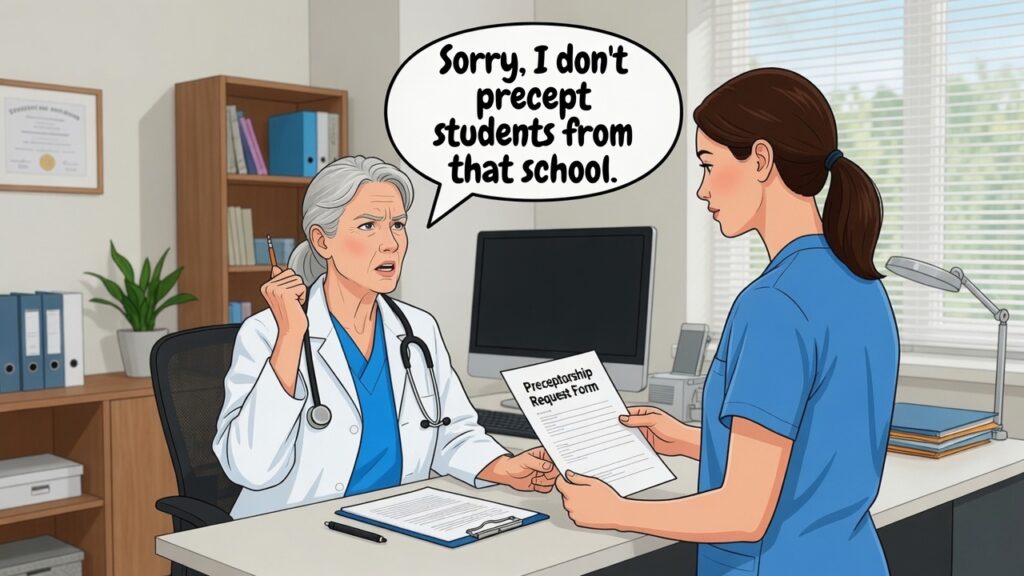
Some preceptors refuse students from certain NP programs because of administrative burden, poor school support, prior negative experiences, mismatched requirements, and concerns about whether the program prepares students well enough for the clinical site. The bigger issue is often not the student personally, but the program’s reputation, communication, or paperwork process, which can make preceptors more selective about who they accept.
Why Do Some Preceptors Refuse Students From Certain NP Programs? The Operational Reputation Problem Behind Hard-to-Place Clinical Rotations
Finding a willing preceptor is difficult in any market. Finding one after a clinician has already decided they do not want students from your NP program is harder, because that refusal is usually based on past workflow friction that cost the clinician time, productivity, or trust.
That distinction matters for both students and preceptors. When clinicians avoid students from certain NP programs, they are often reacting to a school’s operational reputation: how the program handles placement requests, approval steps, paperwork, communication, student vetting, and last-minute changes. For a preceptor balancing patient volume, documentation, and staffing pressure, one poorly managed rotation can create hours of uncompensated work and make the next request from that school an easy no.
They often refuse because some programs have developed a reputation for high administrative friction and weak placement support, not because clinicians are broadly opposed to teaching.
The broader market is already strained. Survey findings frequently cited in NP preceptor workforce discussions show that 60% of NP preceptors were not currently precepting, while 63% identified lack of preceptor education as a major barrier and 65% said they felt unprepared to teach effectively. When those concerns are combined with EHR disruption, productivity loss, and unclear compensation, clinicians become selective very quickly.
Operational reputation influences placement decisions by signaling how much friction a school is likely to create before a rotation even begins.
Preceptors pay close attention to patterns. When a program consistently sends incomplete requests, delays affiliation paperwork, makes last-minute changes, or imposes rigid and sometimes arbitrary requirements—such as dictating how a résumé must be formatted or rejecting applications over minor details like email type—clinicians take note. These experiences can create the impression that the school views the preceptor as needing to meet its standards to “earn” the opportunity, rather than recognizing that the preceptor is taking on additional workload and liability to provide a service that ultimately benefits both the student and the institution, often with minimal compensation for the preceptor.
As a result, even academically strong programs can become difficult to place if their clinical coordination process is perceived as disorganized, overly bureaucratic, or misaligned with the realities of clinical practice.
For many preceptors, a “quality program” usually means:
Students sometimes assume refusal is mainly about online or hybrid delivery. Modality can influence perception, but in many cases, the deciding factor is simpler: Will this school make the rotation manageable, or will it create an unneeded and unwanted burden for myself?
The data suggests the barrier is usually systemic rather than personal.
If 65% of preceptors report feeling unprepared to teach effectively, that points to a support problem. If 60% are not actively precepting, that suggests goodwill alone is not enough to sustain the clinical training pipeline. The headline may be “NP preceptor shortage,” but the operational cause behind many program-specific refusals is friction.
Five issues drive most program-specific refusals: paperwork burden, poor school coordination, unclear expectations, concerns about student readiness, and weak time-to-value for the clinician.
The fastest red flags are the ones that suggest the clinician will lose time and control.
| Red flag | What the preceptor hears | Why it lowers placement odds |
|---|---|---|
| Incomplete placement request | “I will have to chase details myself.” | Signals admin burden from day one |
| Delayed school paperwork | “This may drag on for weeks.” | Creates uncertainty and wasted effort |
| Vague rotation goals | “I do not know what I am agreeing to.” | Raises supervision and evaluation risk |
| Last-minute schedule changes | “My clinic will absorb the disruption.” | Increases workflow pressure |
| Prior underprepared students | “The school may not vet readiness well.” | Damages trust in future students |
| Unclear compensation process | “I may not get paid clearly or on time.” | Makes the commitment feel risky |
Paperwork burden pushes preceptors away because every extra form competes with patient care, charting time, and clinic operations.
If a clinician has to review agreements, clarify school requirements, send reminders, and track deadlines, the rotation starts to feel like a second job. That is one reason many clinicians are skeptical of informal placement methods. Clinical Match Me has addressed similar issues in the Clinical Match Me blog, decoding NP preceptor cost models, and NP preceptor pay structures, refunds, and rotation risk.
Poor school coordination damages trust because it forces the preceptor to become the project manager.
When schools respond slowly, send conflicting instructions, or change requirements after a clinician has tentatively agreed, that experience tends to shape future decisions. A preceptor may never read a program’s curriculum documents, but they will remember a three-week delay on an affiliation agreement.
They usually mean concerns about student readiness, vetting, and support, not just school ranking or brand recognition.
They usually refuse because of prior experiences with paperwork delays, poor coordination, unclear expectations, or student readiness concerns. In many cases, the refusal is about the process attached to the program, not the individual student.
The most useful information is specialty, exact dates, required hours, evaluation expectations, school approval steps, and compensation clarity. Complete information reduces uncertainty and signals professionalism.
Sometimes, but not always. More often, clinicians are reacting to operational problems tied to a program rather than delivery format alone.
The fastest response is to notify the school immediately, confirm whether hours or dates can be adjusted, and restart outreach with complete documentation ready. Delay usually narrows options and increases the chance of a missed rotation. A practical backup approach is outlined in NP clinical placement plan: 10-day rescue workflow.
Yes, if the preceptor is open to another placement and the school’s requirements align. Strong repeat placements usually depend on early communication, clear scheduling, and a process that does not recreate the same administrative burden. Students balancing work and travel constraints may also benefit from planning guidance in NP clinical rotations around commuter life and burnout-proof NP scheduling weekly cadence.
Kane Ray is a healthcare content writer focused on NP education, clinical placements, and preceptor workflow issues. He writes for practitioner audiences with an emphasis on practical decision-making, operational clarity, and the real-world barriers that affect students, schools, and preceptors. His work for Clinical Match Me reflects the company’s clinician-informed perspective on making placements easier to trust.

Ready to find your NP preceptor?
Sign up free and start receiving offers from preceptors in your specialty today.
No credit card required. No obligation to pay.